
Modern living environments are increasingly engineered for physical inactivity. The average adult spends a significant portion of their waking hours in a sedentary state, a behavior directly linked to an increased risk of all-cause mortality. While commercial gyms provide a wide array of tools, the logistical friction of commuting often serves as a barrier to consistent movement. Transitioning to a home-based exercise model isn’t just about convenience; it is a strategic intervention against the physiological decay associated with aging and sedentary lifestyles. When we look at the data surrounding chronic conditions like metabolic syndrome, hypertension, and osteoporosis, the evidence points toward a clear conclusion: consistent resistance and cardiovascular training at home can be as effective as clinical interventions for many individuals. This analysis focuses on the most effective, evidence-based home workout routines for beginners, specifically through the lens of long-term disease prevention.
The Role of Regular Physical Activity in Preventing Metabolic and Cardiovascular Disease
To understand why a home workout routine is necessary, one must first look at the pathology of inactivity. When muscles remain dormant, insulin sensitivity drops. This sets the stage for Type 2 Diabetes. Furthermore, the lack of mechanical load on the skeletal system accelerates bone density loss, particularly in post-menopausal women and aging men. By implementing a structured routine, you are essentially administering a dose of preventative medicine that targets multiple biological systems simultaneously.
Improving Insulin Sensitivity Through Resistance Training
Muscles are the primary site for glucose disposal in the body. When you perform a squat or a push-up, your muscle cells recruit glucose transporters to the cell surface. Research indicates that even moderate-intensity resistance training can significantly lower HbA1c levels in individuals with pre-diabetes. For a beginner, the goal is not hypertrophy (muscle size) but rather the metabolic efficiency that comes with regular muscle activation. By engaging large muscle groups—the quadriceps, glutes, and latissimus dorsi—you create a larger “sink” for blood sugar, which directly mitigates the risk of metabolic dysfunction.
Cardiovascular Adaptation and Blood Pressure Regulation
Aerobic capacity, often measured as VO2 max, is one of the strongest predictors of longevity. A beginner routine that incorporates heart rate elevation helps to strengthen the myocardium (heart muscle) and improve the elasticity of the vascular system. This reduces peripheral resistance, which is a fancy way of saying it lowers your blood pressure. Even without expensive treadmills, movements like high knees, mountain climbers, or brisk walking around the block can induce these changes. The key is maintaining a heart rate within Zone 2—roughly 60-70% of your maximum heart rate—where the body becomes more efficient at oxidizing fat and improving mitochondrial density.
Evidence suggests that just 150 minutes of moderate-intensity exercise per week can reduce the risk of cardiovascular disease by up to 30%. For those starting at home, the focus should be on accumulation rather than intensity.
A Science-Based Full-Body Strength Training Protocol for Beginners
A common mistake beginners make is following a “split” routine where they train different body parts on different days. For someone starting out at home, a full-body routine performed three times a week is far superior. This approach ensures that every major muscle group is stimulated frequently enough to trigger adaptation without causing excessive soreness that might lead to quitting. The following routine focuses on the five primary human movement patterns: the squat, the hinge, the push, the pull, and the core brace.
The Big Five Movement Patterns for Home Workouts
- The Squat (Knee Dominant): Focus on the glutes and quadriceps. Stand with feet shoulder-width apart, sit back as if into a chair, and return to standing. If bodyweight is too easy, hold a gallon of water or a heavy book.
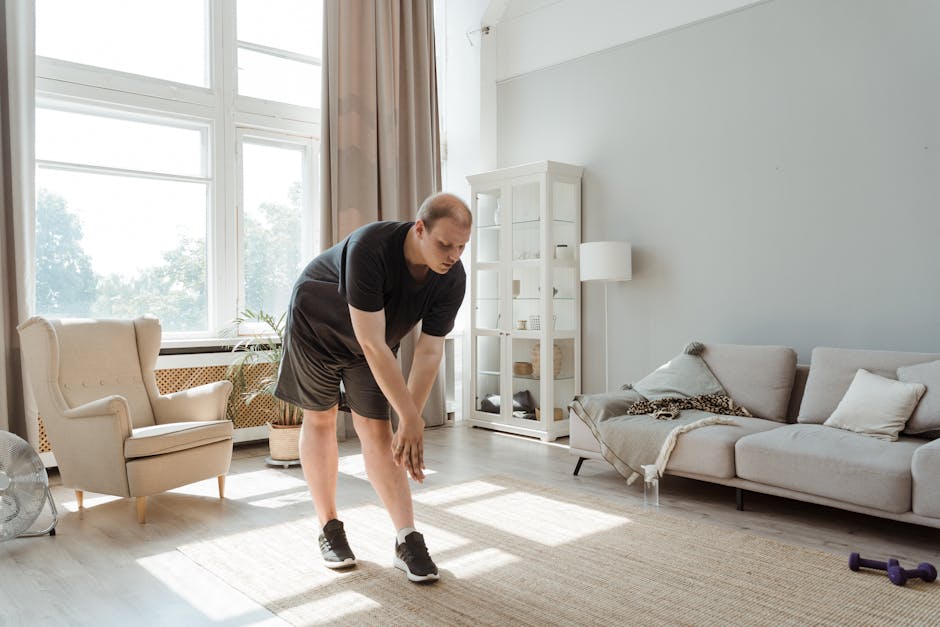
- The Hinge (Hip Dominant): Essential for lower back health and posterior chain strength. This is the movement of bowing at the waist while keeping a flat back. It targets the hamstrings and glutes.
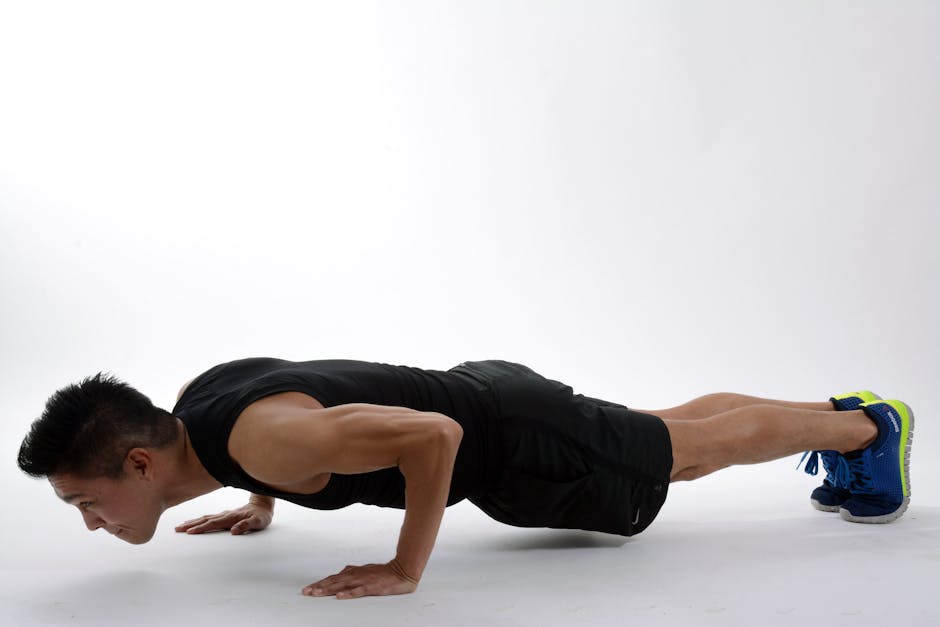
- The Push (Horizontal or Vertical): The classic push-up is the gold standard here. Beginners can start with their hands on a kitchen counter or a sturdy table to reduce the load, gradually moving to the floor as strength improves.
- The Pull (Horizontal): Often the hardest to do at home without equipment. A “doorway row” or using a sturdy table to pull your chest toward the underside is effective. This targets the upper back and prevents the rounded-shoulder posture common in office workers.
- The Core Brace: Forget sit-ups. The plank or the “dead bug” exercise teaches the core to stabilize the spine, which is the primary function of these muscles in daily life.
Sample 30-Minute Beginner Home Routine
| Exercise | Sets/Reps | Rest Period | Primary Benefit |
|---|---|---|---|
| Bodyweight Squats | 3 Sets of 12-15 | 60 Seconds | Lower body bone density |
| Incline Push-ups | 3 Sets of 8-10 | 90 Seconds | Upper body strength |
| Glute Bridges | 3 Sets of 15 | 60 Seconds | Hip stability/Back health |
| Doorway Rows | 3 Sets of 12 | 60 Seconds | Posture correction |
| Plank Hold | 3 Sets of 30s | 60 Seconds | Spinal stabilization |
Resting between sets is not wasted time; it allows the ATP (adenosine triphosphate) in your muscles to replenish, ensuring that your next set is performed with high-quality movement. Quality of movement always takes precedence over the number of repetitions. If your form breaks down, the set is over.
Essential Home Equipment for Beginners: A Comparison of Retail Options
While bodyweight exercises are a perfect starting point, the principle of progressive overload dictates that you must eventually increase the resistance to continue seeing health benefits. Investing in a few key pieces of equipment can significantly expand the variety and effectiveness of your home workouts. You do not need a multi-thousand-dollar home gym; you need tools that offer versatility and take up minimal space. Retailers like John Lewis and Argos (available through Awin retail partners) often stock these essentials.
Adjustable Dumbbells vs. Resistance Bands
The debate between free weights and bands often comes down to storage and budget. For a beginner, resistance bands are the most cost-effective entry point. They provide linear variable resistance, meaning the exercise gets harder as the band stretches. This is excellent for joint health but can be difficult to track progress with precisely. Adjustable dumbbells, on the other hand, provide a consistent load and a more traditional lifting experience.
- Bowflex SelectTech 552 Adjustable Dumbbells: These are a premier retail choice, replacing 15 sets of weights in one unit.
Approximate Price: £429 / $400
Pro: Extremely space-efficient and easy to change weights between 2kg and 24kg.
Con: High initial investment and the mechanism can be fragile if dropped.
- Manduka PRO Yoga Mat: Essential for floor work and joint protection.
Approximate Price: £100 / $120
Pro: Superior cushioning and a lifetime guarantee.
Con: Heavier than cheap foam mats and requires a “break-in” period to lose its initial slickness.
- Fitbit Charge 6: A critical tool for tracking heart rate and sleep recovery, available through many telecom and retail partners.
Approximate Price: £140 / $160
Pro: Excellent heart rate tracking and integration with Google Maps/YouTube Music.
Con: Requires a monthly subscription for advanced data analytics.
Selecting the Right Surface and Environment
The environment in which you exercise influences your psychological readiness. If possible, designate a specific 2×2 meter area in your home as your workout zone. Using a high-quality mat like the Manduka PRO mentioned above defines the space. Hardwood or laminate floors are better for stability during standing exercises like squats, while carpeted areas might require a firmer mat to prevent slipping. From a safety perspective, ensure you have adequate ventilation; even a small fan can prevent the premature fatigue caused by overheating in a confined indoor space.
Overcoming Common Barriers to Consistency and Long-Term Habit Formation
The greatest challenge in home fitness is not the physical exertion, but the absence of the “gym environment” that naturally cues the brain to work. At home, the couch and the refrigerator are constant distractions. To successfully prevent chronic disease, the routine must move from a conscious effort to an automatic habit. This requires an understanding of behavioral psychology and the removal of as much friction as possible.
The Concept of Friction and Habit Stacking
Friction is anything that makes it harder to start your workout. If you have to move a coffee table, find your shoes, and clear a space, you are less likely to exercise. Minimize this by laying out your clothes the night before or keeping your dumbbells in plain sight. Habit stacking is another powerful tool: perform your 10-minute mobility routine immediately after your morning coffee or while your evening tea is brewing. By anchoring the new behavior to an existing one, you bypass the need for raw willpower, which is a finite resource.
Tracking Progress Beyond the Scale
Many beginners quit because they don’t see immediate weight loss. However, weight is a poor metric for disease prevention. Muscle is denser than fat; you might be losing fat and gaining muscle while the scale stays the same. Instead, use a wearable like the Fitbit Charge 6 to track your Resting Heart Rate (RHR). As your cardiovascular system becomes more efficient, your RHR will drop. This is a tangible sign that your heart is getting stronger and your risk of cardiac events is decreasing. Additionally, track your strength: if you could do 5 push-ups last week and can do 7 this week, your nervous system is adapting and your bone density is being protected.
Progress is rarely linear. There will be weeks where work or family obligations interfere with your routine. The deep researcher’s perspective suggests that the goal should not be perfection, but a high “compliance rate.” If you hit 80% of your scheduled workouts over a six-month period, the physiological benefits will be profound. The objective is to build a body that is resilient to the stresses of aging, and that requires a long-term commitment to the fundamentals of movement, regardless of whether that movement happens in a high-end gym or your own living room.